Search Artists
 Search Disciplines
 Search
Places
Search
Places
Image
Image

Role
Advisor for Hungary, Poland, Ukraine & Turkiye
Email
t.stepanovic [at] dutchculture.nl

 Maas Theatre and Dance Angerfist Wil Salden Simone Lamsma Andrea Hackl
 Education
 Portugal
China
Turkey
Stockholm
Miami
Chicago
Portugal
China
Turkey
Stockholm
Miami
Chicago
For this series, DutchCulture invited the Ukrainian Institute to help select four essays that offer international readers a deeper understanding of Ukrainian culture through the eyes of its own critics, curators, and thinkers. Spanning cinema, photography, exhibition-making, and women’s artistic practices in wartime, the texts reflect on identity, ideology, landscape, memory, and survival. Three of the four articles had not previously been available in English and were translated by DutchCulture for this series. Together, they form a small but rich constellation of perspectives on Ukrainian culture past and present.
This second article, by Illia Levchenko, looks at the Dnipro River as a landscape shaped by ideology, violence, and memory. Through the exhibition The River Wailed Like a Wounded Beast at the Dovzhenko Centre, it traces how art and film reveal the long history of transforming the river, from Soviet industrial ambition to the destruction of the Kakhovka dam.
The 5th Kyiv Biennale, which opened with an exhibition at the Dovzhenko Centre, is taking place in Kyiv, Ivano-Frankivsk, Uzhhorod, Berlin, Antwerp, Warsaw, Lublin, and Vienna. Its practices of reintegration and the search for spaces to foster critical knowledge continue the legacy of the Visual Culture Research Centre (VCRC) as the main organiser of the biennale.
In 2012, shortly after Serhiy Kvit shut down the exhibition Ukrainian Body—which he dismissed as "It’s not an exhibition, it’s shit"—the academic council of NaUKMA, led by Kvit, dissolved the Visual Culture Research Centre and deprived it of its space. Today, institutional homelessness, Bauman’s concept of "transcendental homelessness," and the global dispersal of Ukrainians due to war and the post-COVID era have normalised nomadism as the only viable means of interaction in the face of these challenges.
The biennale’s organisers emphasise that its events are taking place in institutions on the verge of closure—yet they continue to operate. In Kyiv, the exhibition The River Wailed Like a Wounded Beast is hosted at the Dovzhenko Centre, which faces the threat of erasure or even destruction due to land-grabbing schemes and efforts to replace independent professionals with individuals for whom “everything is mixed together—cinema and dogs.”—Illia Levchenko, art historian.
Nature does the same to humans as it does to the rest of her creations: it acts on their behalf where human is not yet capable of acting as a free intellect.
The theme of the exhibition at the Dovzhenko Centre is the history of the “transformation” of the Dnipro River from the early 20th century to the destruction of the Kakhovka Hydroelectric Power Plant—an event that served as the catalyst for choosing this theme, explains Stanislav Bytiutskyi, one of the curators.
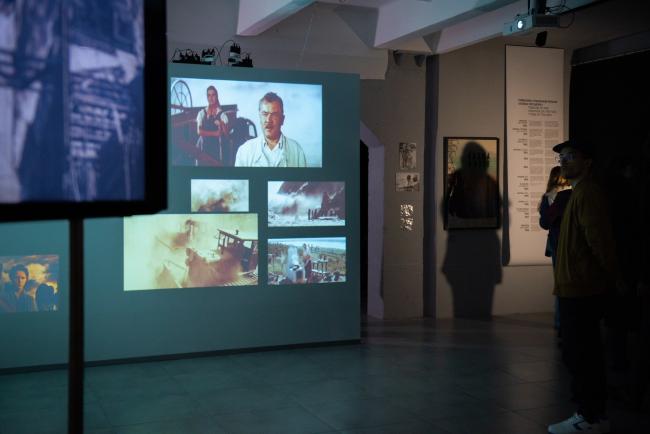
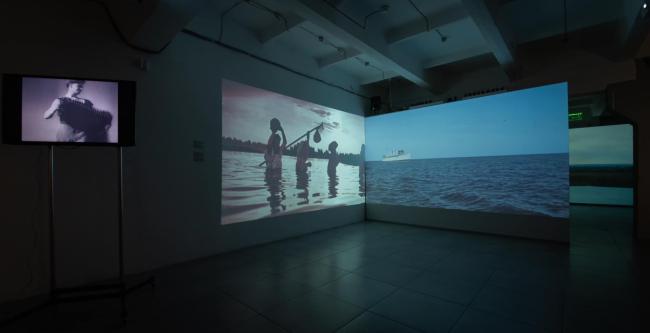
Relevant and instantly recognisable to anyone following current events, the exhibition unfolds in the linear and minimalist space of the first hall of the Dovzhenko Centre. Each phase of the river’s transformation is presented separately—from the beginning of the construction and the launch of the Dnipro Dam to the devastation caused by the Russian army’s destruction of the Kakhovka hydroelectric station reservoir.
The Dnipro Roars explores the river’s natural floods on Trukhaniv Island, the early concept of hydroelectric stations, and the research expeditions led by Dmytro Yavornytsky. The Dnipro in Concrete examines industrialisation, the construction of the Dnipro Hydroelectric Station, the glorification of socialist labour, and the transformation of the landscape. A Sea of Tears focuses on the grand construction of the Kakhovka HPP in accordance with Stalin’s Plan for the Transformation of Nature. Only the Dnipro and the Sky, the final hall, juxtaposes Leonid Osyka’s poetic cinema with testimonies from survivors of the 2023 dam destruction.
Each period and each hall is connected through an open pathway, guiding visitors through a linear narrative of destruction—where the right wall represents the Dnipro Rapids, and the space between the two walls leads to a Kherson landscape filmed in 2023.
Of course, this linearity is an illusion. On 6 June 2023, we woke up to the horrifying footage of houses being carried away by the Dnipro’s waves, animals with no chance of survival, and people climbing onto rooftops, desperately trying to escape the flooding.
This radically alters how we perceive the film fragments presented in the exhibition. Several key cinematic movements in Ukrainian film history—the avant-garde experiments of the 1920s (Mykhailo Kaufman, Dziga Vertov, Arnold Kordium), the socialist realist epic Poem of the Sea by Solntseva-Dovzhenko, and Leonid Osyka’s first poetic film, are no longer just history but its representation.
A post-catastrophic (Wikipedia even defines it as the "Kakhovka Catastrophe") perspective forces us to view every element of this exhibition as a monumental act of representation, where the joy of labour, awe and enthusiasm are forever marked by disaster.
If asked what has happened to us over the past year and a half, one possible answer is: we have witnessed a catastrophe being created, disguised as the beauty of a landscape. Or: we have learned to discern ideology. This is one of Žižek’s favourite phrases: he constantly insists that there are no places untouched by ideology. Instead of searching for them, we must learn to recognise ideology, choose it, or even use it. This applies to nature above all, which is why so many Ukrainian artists today are working with the theme of landscape. A post-catastrophic perspective reveals that the symbolic representation of nature is constructed, repeating itself while concealing traces of intervention and sacrifice.
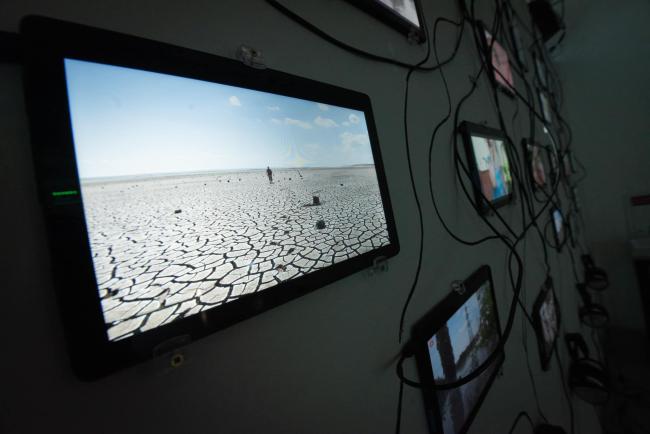
There have been many kinds of sacrifices. Not only those who were killed, maimed or displaced, but also cultural heritage, drowned during the construction of hydroelectric power plants. Houses, gardens, graves, entire towns vanished beneath the water.
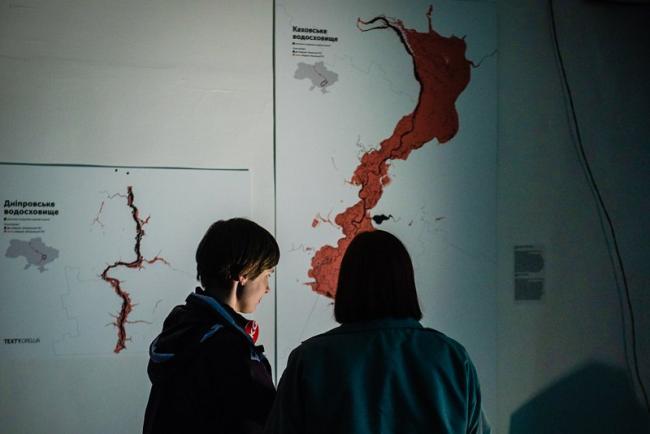
The exhibition features an infographic, developed in collaboration with designer Nadiia Kelm, showing the Dnipro River’s course before and after the construction of hydroelectric dams. The scale of destruction is staggering—in some places, the "resettlement" zone expanded tenfold. One character in Poem of the Sea remarks that the town of Novoheorhiivsk, which is “valued at 940 million rubles”, will soon be demolished, but the “gain in energy will be two billion”.
A glance at Wikipedia’s entry on this town reveals:
"The land where Kryliv was situated once belonged to the Kyiv kahanat and later to the Kyivske knyazivstvo and was well known to the Slavs. For example, the Kyiv Chronicle states: 'In the same (1190) year, Sviatoslav and his father-in-law Rurik, having pacified Rus' and subdued the Polovtsians to their will, set out on a hunting trip along the Dnipro in boats, reaching the mouth of the Tiasmyn, where they hunted and captured countless wild animals.'"
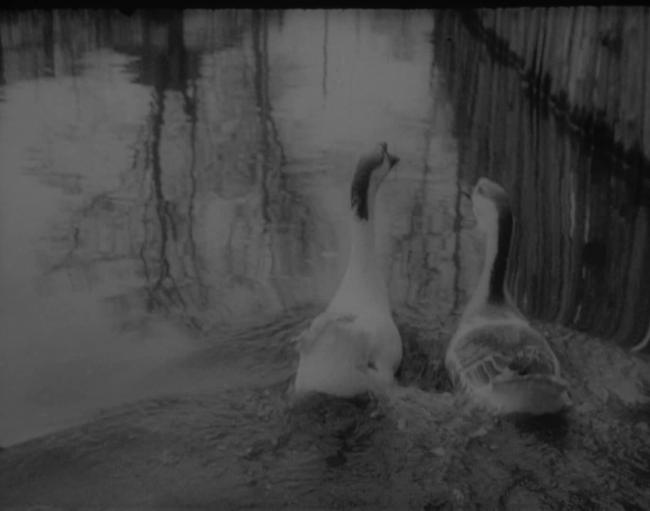
To this day, the left-bank floodplain of the Tiasmyn river remains covered in forests and swamps, teeming with wildlife. The dense thickets are home to deer and wild boar, while many waterways are still marked by beaver dams. How many towns and landscapes were sacrificed to industrialisation in order to "gain" some billions?
"We stood on the shore, listening to the roar of the agitated river. The river wailed like a wounded beast. Blue blood flowed from the wound of the shaggy beast." The roar and the blue blood have since been replaced by still waters, clouds above them, sunsets and sunrises—scenes that appear in Solntseva’s film. Mykola Bazarkin, who created a montage from fragments of the film, chose episodes featuring landscapes. Surprisingly, they resemble the works of Vasylkivsky or Kuindzhi: 19th-century ethnographic landscapes, depicting empty, tranquil spaces where the eye finds rest in watching water and sky, or, conversely, landscapes populated by labourers.
Yet in the exhibition and Bazarkin’s work, aesthetic enjoyment is fundamentally inaccessible. Directly or indirectly, everything that lies beyond this "beauty" comes into view.
Another important quote in the Dnipro Roars hall belongs to Oleksandr Dovzhenko: "Between truth and beauty, I choose beauty."
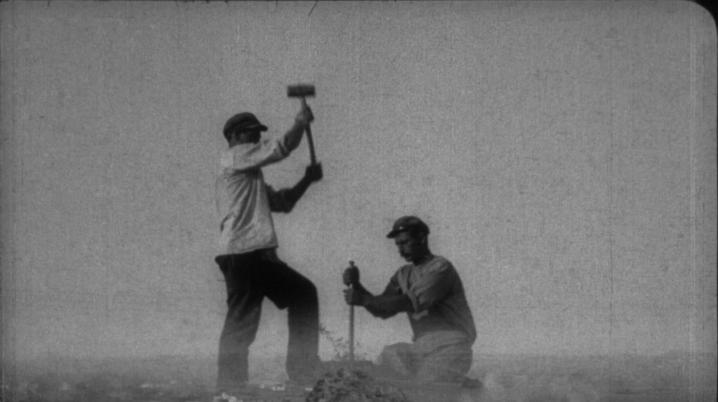
Beauty that conceals truth, evades it, or becomes a refuge for those who would have faced concentration camps—and thus, slow or sudden death—for telling the truth. History, it seems, has a tendency to preserve beauty far more persistently than truth. Black-and-white photographs from early 20th-century expeditions, capturing elevated landscapes; the waters of the Dnipro, which swallowed numerous towns and villages; ducks gently gliding in the spring—these scenes quickly begin to resemble idyllic places (locus amoenus). But on the exhibition floor, the scream of a wounded beast is muffled, transformed into ultrasound. The curators juxtapose film fragments, quotes, melancholically tense music, composed especially for the exhibition by ambient musician and composer Oleksii Podat.
This is one of those rare instances where the exposition of audio-visual material, complemented by a musical score, blends into a strikingly cohesive whole. One feels a tenderness in the care for each and every fragment, which—whether they complement or contradict one another—together form a unified entity. Podat’s music, written amid ruins, binds everything together through inversion. It is a punctum—that wounds, cuts through, fractures and reassembles the whole from shards. That is why neither posters, nor photographs, nor the most ideologically charged scenes from the film Poem of the Sea can be perceived from within, without a distance, without a conscious awareness of discourse.
The exhibition concludes with a video artwork by Yarema Malashchuk and Roman Khimei; the only work created prior to the exhibition, not for it. View of the Temporarily Occupied Left Bank of the Kherson Region, made in the spring of 2023, was essentially a state commission, created for the World Economic Forum in Davos.
A landscape with the Dnipro, framed by shattered glass, broken by shelling, from the window of a Kherson school. Next to Malashchuk and Khimei’s work is Leonid Osyka’s poetic cinema, with its beach as a topos, the whisper of sand, the aura of an unrealised sexual revolution. In both cases, a frozen spectacle conceals a tension—one that inevitably leads to action, sudden yet carrying long-term consequences, as does any tragedy.
Translated by Yuliia Elyas