Search Artists
 Search Disciplines
 Search
Places
Search
Places
Image
Image

Role
Advisor for Hungary, Poland, Ukraine & Turkiye
Email
t.stepanovic [at] dutchculture.nl

 Sam Ghezzi Epica Viking Film San Holo Annabelle Lopez Ochoa
 Education
 Japan
Denmark
Germany
Edinburgh
Turin
Milan
Japan
Denmark
Germany
Edinburgh
Turin
Milan
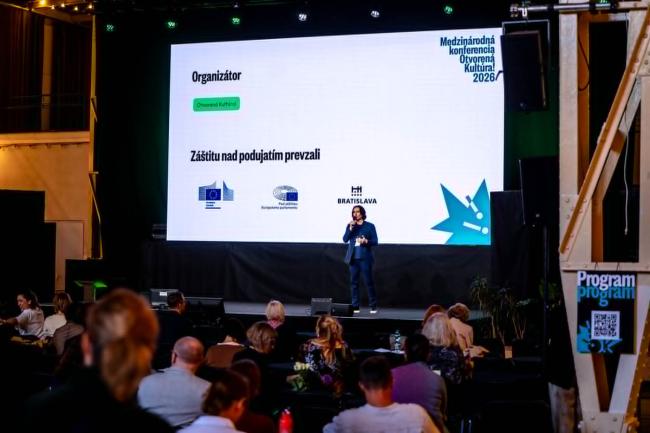
In Slovakia, independent culture is under severe political pressure. The cultural platform Otvorená Kultúra! is responding not only with protest, but also with plans for recovery, solidarity and European action. At its Open Culture! International Conference 2026 in Bratislava last May, one question stood out: could a European Artistic Freedom Act, a legal framework, help protect artists and cultural institutions from political interference — in Slovakia and beyond?
The author of this piece, Gergely Nagy, is a cultural journalist, editor, and author. He lives and works in Budapest, currently works for Qubit.hu, and is a PhD fellow at ELTE University in Budapest. His main fields of interest are contemporary art, cultural policies and cultural resistance. Nagy contributed to several in-depth reports dealing with the state of artistic freedom and freedom of speech.
Few things can give hope today to Slovakia’s cultural workers, artists, and creators, but the group Otvorená Kultúra! (OK!, Open Culture!) and the actions and events it organizes certainly belong among them.
OK! was founded more than two years ago in response to the fact that Robert Fico’s government launched a brutally aggressive campaign against cultural institutions and against those artists and creators whom it identified as “liberal”, or critical of, or in any way threatening to, the existing power structure. Initially, OK! made its presence felt through petitions, demonstrations, and strikes. But beyond the tools of protest, it also began to develop methods of constructive resistance. For example, this May it held its second international conference in Bratislava.
For a long time, Slovakia and Hungary were mentioned together as Europe’s two experimental laboratories of illiberal (and pro-Putin) political systems. However, what successive Orbán governments accomplished in Hungary’s cultural sphere over many years — building up the cultural hegemony, reshaping of institutions and the legal framework completely, and the marginalization of critical culture — the Fico government and its Minister of Culture, Martina Šimkovičová, sought to push through in just a year to a year and a half. Fico gave the Ministry of Culture to the nationalist SNS party and their guiding slogan was: “Slovak culture must be exclusively Slovak.” In the name of this principle institutional leaders were fired, most notably Matej Drlička, the director of the National Theatre. Cultural venues were shut down, including Bratislava’s hard edge Kunsthalle. Incompetent but ideologically compliant managers were installed in key positions. Public funding for progressive culture was gradually eliminated, and, of course, critical voices were cut off from the public sphere.
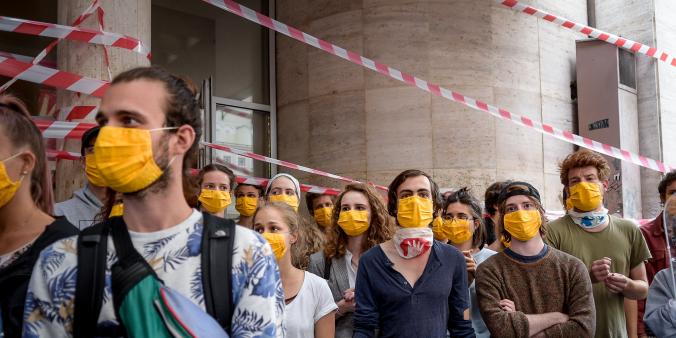
Who would have thought that a protest letter written by an artist, Ilona Németh and a scholar-researcher, Ivana Rumanova could break through the media threshold and launch a mass movement? But this is exactly what happened. The letter was signed by 188.000 people in a few days which is a huge achievement in such a small country. And what began as a protest became a national issue; what became an issue turned into a movement, namely OK! — and that movement may yet evolve into a political force.
It is true that, in some respects, building a unified front in Slovakia may have been “easier” than in Hungary, because the intellectual sphere there is less divided, and because the Fico government went at institutions with a blunt instrument. They did not know—or did not choose to apply—Orbán’s subtler methods: lucrative offers of power, co-optation, bribery, corruption, and the sleight-of-hand tactics of political illusion-making.
While Hungary underwent a radical political change in April 2026 and the Orbán regime fell after sixteen years in power, the May symposium organized by OK! in Bratislava took place under dark clouds and in a rather depressive atmosphere.
At this time last year, the spirit of protest was still vibrant. OK! had succeeded in building a genuinely powerful front against the Fico government: from folk singers to queer performers, from musicians to museum professionals. By now, however, the resistance has somewhat exhausted itself—which is hardly surprising, since it is impossible to protest, strike, and demonstrate every single week.
For this reason, the OK! event sought to present a “recovery plan” aimed at rebuilding Slovakia’s cultural system, inviting experts and opposition politicians to contribute to the discussion. As stated in OK!’s official declaration: “This is a comprehensive plan containing dozens of concrete measures and solutions, intended as a practical guide for the future leadership of the Ministry of Culture. Its goal is to halt the destruction of the cultural ecosystem, initiate recovery, and strengthen resilience.”
The conference also showcased examples of cultural resistance, including the case of Budapest’s University of Theatre and Film Arts (SZFE). The story of the community that resisted the government-driven privatization of the university was told in a compelling presentation by László Upor, a representative of FreeSZFE, the “counter-university” established by dissident faculty members and students who left the institution.
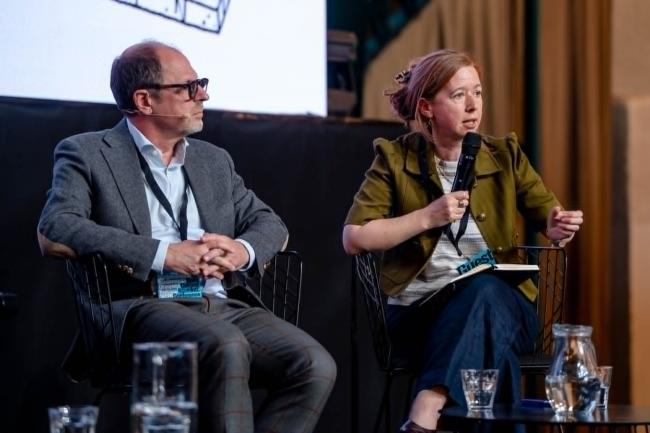
The second day of the conference focused on the broader European context and on discussions surrounding the preparation of the European Artistic Freedom Act. The draft legislation is currently being developed, and its primary objective is to protect the cultural environment and artistic work from political interference. According to experts, the legislation could be grounded in the functioning of the European Union’s internal market, making it more feasible for adoption at the EU level. The proposal also addresses the protection and security of artists, including measures to facilitate access to visas and to strengthen the legal protections available to creators coming from outside Europe. One of the principal initiators of the plan is the Artistic Freedom Initiative (AFI), a civil organization based in New York and Geneva. AFI has monitored cultural policy developments in countries such as Hungary, Poland, Slovakia, Afghanistan, and, most recently, the United States through highly detailed and exceptionally insightful country reports. These reports provide a thorough assessment of the state of artistic freedom and cultural policy, documenting political pressures, cases of censorship and self censorship, institutional changes, and challenges facing artists and cultural institutions (the Slovak report is titled “Early Warning: The Politicization of Slovak Arts and Culture” and is free to download from AFI’s website).
OK! is therefore not alone in its ambitions and plans. Of course, for the Slovak “recovery plan” to become implementable, someone from the current opposition would first need to win the next parliamentary election. It is scheduled for next year, but none of the opposition politicians who appeared on the stage of Bratislava’s Old Market Hall (Stará tržnica) projected an image of overwhelming political strength. The party representing Slovakia’s Hungarian minority did not attend the event at all—perhaps because, following Orbán’s downfall, it is still uncertain about how to reposition itself within its own local political context. Meanwhile, in Bratislava, many people are talking about Hungary and the lessons that might be drawn from recent developments there. This marks a striking contrast to the first OK! conference held in May of last year, when the Slovak resistance was seen as the inspiring example, while in Hungary there appeared to be little sign of the political and social energy necessary to bring about change.
Today, the situation seems almost reversed: Hungary has become a frequent reference point in discussions about political transformation, while many Slovak cultural actors are searching for ways to sustain momentum and envision a path forward amid an increasingly hostile political climate. As these lines are being written, we already know that Slovakia’s national arts funding body, the Slovak Arts Council (FPU), has awarded zero euros to several major cultural organizations, including independent theatre and dance festivals such as Divadelná Nitra and Bratislava in Movement, and has drastically reduced support even for traditional folklore festivals with a long-standing history. Artist groups, independent journals, small galleries, book publishers are facing the threat of closure. This is a stage that the Orbán regime in Hungary reached only after roughly twelve years in power. Fico’s government—and Martina Šimkovičová, who entered politics from the world of right-wing disinformation influencers—has managed to reach it in just two years.
Both last year’s and this year’s OK! conference sought to answer the same question: what kind of strategy can be effective under these circumstances?
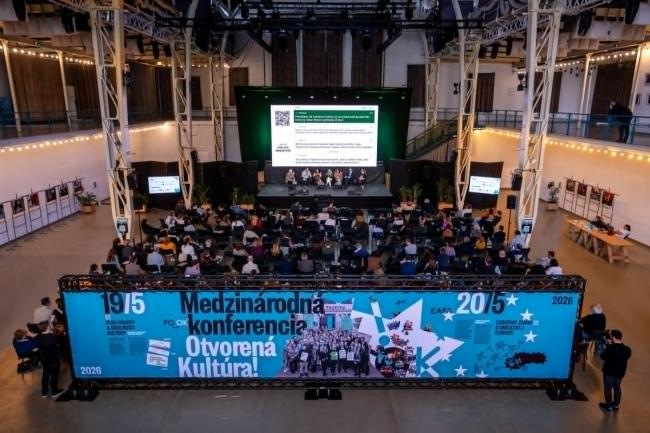
Last year, the emphasis was on local resistance and international solidarity. This year, the prospect that emerged was that of coordinated, collective international action. While the Bratislava Declaration adopted last year articulated the fundamental principles of artistic freedom in Europe at a largely normative level, the European Artistic Freedom Act is now attempting to carry that work into the realm of legislation and policy-making. If it succeeds in bringing into force, in 2024, the European regulation on media freedom, then on that basis a similar regulatory framework could be created in the cultural sector as well, and individual EU member states could be required to align their own rules with the EU regulation.
If we began with hope, let us end with it as well.
Slovakia, on the one hand, still remembers that civic resistance has achieved success here before. Mass protests against the Mečiar government and later against the Fico government were effective—Mečiar was forced out in 1998, and Fico in 2018. There is a historical experience that collective action can lead to results.
Culture, too, has proven resilient, at least so far. The revitalization of the Old Market Hall, which hosted the conference, is itself the result of civic activity—in which, among others, Slovak-Hungarian activist Gábor Bindics played a key role, together with his collaborators, having already helped revive several disused urban spaces and make them the hubs of civil activities. This practice offered an alternative: how to achieve results and gain positions through democratic means, even amid authoritarian tendencies.
This also highlights that it matters what conception of culture the civil sphere, OK!, or the actors behind the European Artistic Freedom Act adopt. If culture is understood narrowly as artistic production alone, it may not be able to become a shared cause for everyone. But if culture is understood as a broader set of emancipatory and opportunity-creating practices, it may be able to mobilize wider social support.
Such mass pressure will be necessary if Slovakia’s cultural workers truly want to bring about change.