Search Artists
 Search Disciplines
 Search
Places
Search
Places Circus Katoen
 Education
 Turkey

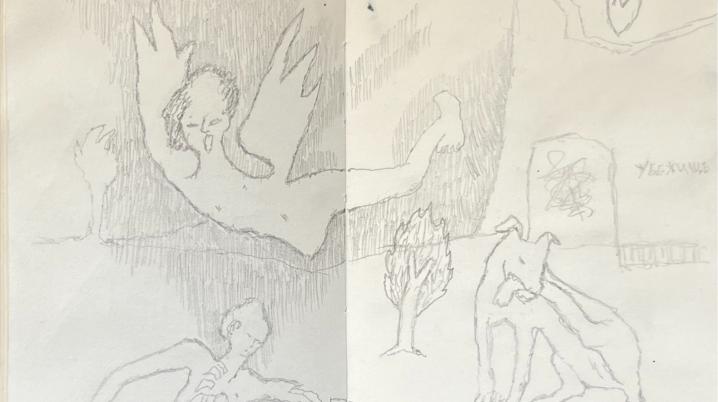
A Unit After Zero: The Cloud Archive on the Edge of the Abyss - Women Artists at War
For this series, DutchCulture invited the Ukrainian Institute to help select four essays that offer international readers a deeper understanding of Ukrainian culture through the eyes of its own critics, curators, and thinkers. Spanning cinema, photography, exhibition-making, and women’s artistic practices in wartime, the texts reflect on identity, ideology, landscape, memory, and survival. Three of the four articles had not previously been available in English and were translated by DutchCulture for this series. Together, they form a small but rich constellation of perspectives on Ukrainian culture, past and present.
As war devastates cities, museums, landscapes, and lives, the question of how to protect culture becomes increasingly urgent. Digital archives offer one way of preserving artistic practices and personal testimonies that might otherwise be lost. Through the Secondary Archive and the voices of Ukrainian women artists, this article, written by Natalia Matsenko, introduces a broader reflection on art, memory, and survival under wartime conditions.
Culture Under Attack
How do you protect culture during wartime? How do you preserve Ukrainian art? These were the questions posed by a foreign journalist preparing a piece on the Russian occupation and war in Ukraine. We recall the museums of Kharkiv and Kherson, the evacuation and looting, the repetition of World War II scenarios, the disappearance of the artist and founder of the Kherson Museum of Contemporary Art, Slava Mashnytskyi, in occupied territory, and the destruction of Polina Rayko’s house-museum following the destruction of the Khakovka dam. Earlier, we had discussed related topics with a fellow artist and architect who was designing a long-planned bunker specifically for the purpose of preserving art. Today, as I write this text, Russian missiles struck one of Europe’s largest full-cycle printing houses in Kharkiv. There are fatalities and injuries, and over 45,000 books have been burned. Reality has long surpassed the plots of most well-known literary dystopias.
At a time when physical space is being erased to its foundations and turned to ash along with cultural heritage, the digital archive emerges as one of the instruments of preservation—a cloud backup of fragile material reality. It cannot prevent destruction but can preserve data and access to it—at least as long as the servers remain intact.
Aside from ensuring the preservation and accessibility of materials, an open digital archive also offers a significant advantage in making them visible. Because of this, in the post-war world (after World War II), digital platforms began to be actively used for feminist archives aimed at balancing the representation of overlooked female figures in art history and amplifying their presence. Examples of such platforms include the French AWARE, the German Bildwechsel, and the American WAAND at Rutgers University. Most of these initiatives are based in Western Europe or America and focus on the art of these regions.
The Secondary Archive and the Ukrainian Section
A few years ago, the Secondary Archive entered into this field of increasing visibility: a digital archive that not only highlights the work of women artists but also focuses on the underrepresented history of Central and Eastern European art through the lens of gender. The archive specifically includes the practices of women artists born after World War II. One of its key features is that this history is narrated from the perspective of the artists themselves, through their own written statements—primary records created directly in digital form. Established by the Katarzyna Kozyra Foundation, the archive seeks to challenge existing hierarchical and binary frameworks in art history and feminist discourse alike. Dedicated to post-war non-Western women's art, this archive embodies both strength and fragility—especially poignant in a time when the post-war era is once again turning into a wartime one. The non-dominant and the ephemeral become tools in the fight against hierarchical and imperial structures—a struggle that is reaching its culmination in this very war.
In the winter of 2022, the Secondary Archive was expanded to include the first fifty statements by Ukrainian women artists. The online presentation of this new addition took place at a critical moment: on the evening of 23 February.
Within hours, the curators and participants of the Ukrainian section would awaken in a different reality—fragmented. Language would disintegrate into ashes and shards. Words would lose their previous meanings while simultaneously acquiring the status of testimony, gaining a charged significance, spoken at the edge of the abyss. Or, indeed, within it.
“Texts constantly demand some kind of recognition. Vain, neurotic recognition. The text needs to lean on the edge of a hole or arrive on a bomb; it cannot stand on its own. At the same time, it wants to immediately overcome the hole, go through it or turn it around, stop the bomb, distract it with itself.”
This note by Katya Libkind serves as the epigraph to her statement, which was included in the Secondary Archive two years later (under the curation of Kateryna Iakovlenko, Oksana Briukhovetska, and Alya Segal). This statement was written in dialogue with the texts of other artists in the archive and took the form of a play. Katya is one of 15 contemporary Ukrainian women artists whose names were added in March 2024, two years after the previous presentation and the start of the full-scale invasion. The project, Secondary Archive: Women Artists at War, was implemented in collaboration with Artsvit Gallery (Dnipro) and Galeria Labirynt (Lublin). The coordinator of the Ukrainian section of the project is Iryna Polikarchuk. Along with the works and texts of the new authors, a new hashtag has been added to the archive's list: #war.
Language, in a state of both disintegration (and reassembly), becomes a tool for capturing the transitional state and the fragile contours of the present, which, despite its instability, can still take shape.
Through the texts of women artists, Secondary Archive does more than just preserve information about their practices: it expands our perspective on them. It captures, in the first person, thoughts, views, emotions, doubts, transformations of methods, and the evolution of the artists' language at a specific moment in time. In this case, a historic moment.
These texts are not merely commentaries on the visual component, but independent creations, some of which take on distinctly artistic forms. In the latest edition, the authors reflect on the changes in their practices and priorities under the influence of war. Among their reflections echoes a question, well-worn since the 20th century yet still relevant: What is the place of art during war? What can it achieve alongside life—and especially alongside death?
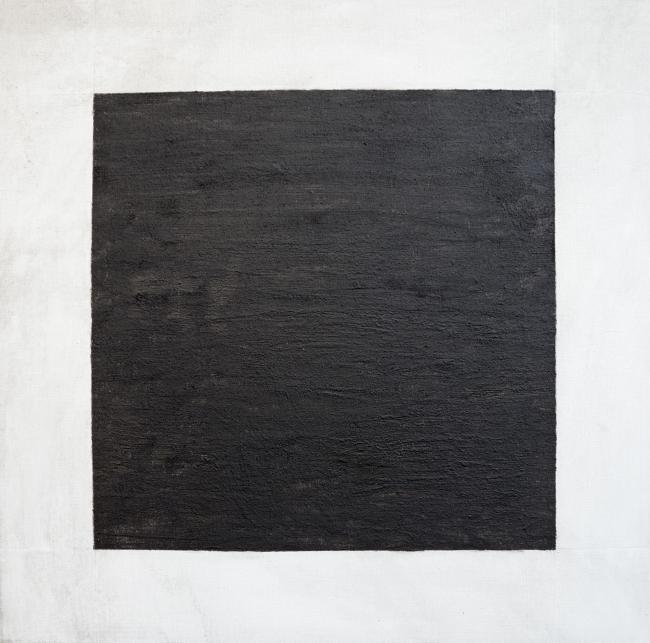
Katya Buchatska, commenting on her Black Square, created from soil taken from the front line (Black from Zero), summarises her statement with these words: “Here comes a time when the idea of art from the zero line becomes a point on the map. The front line is moving; zero lines become the rears of besieging; minuses and pluses become zero lines. It’s like the Undertaker in Malevich’s 1913 sketch carrying a black square as a flag, and then 110 years later, you find yourself digging in the black darkness of the soil, passed down to you by a warrior from the zero line; art and life, which is stronger than art, blend together.”
Bruno Latour (1) , in one of his last texts published during his lifetime and addressing the war in Ukraine, speaks of the European soil as peat, as an earth thick with life. This soil, whose resources and components are attacked and destroyed one by one, is burdened by ecological transformation, rematerialisation, and, according to Latour, the clearest example of this transformation is the link between Russian gas and oil and military and environmental strategy. In Latour’s view, this century demands that Europe recognise itself as not only a political union but as a shared ground, bound together by all its elements and complexities.
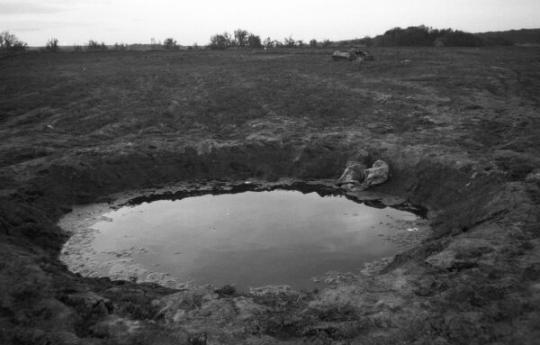
It is into the depth of this soil that Kateryna Aliinyk peers. Her native landscape of Luhansk, now inaccessible to her, has for the past decade become a place of personal encounter—with her land, with the landscape of war.
"War and the observation of nature are the most sensual, voluminous, and long-lasting experiences of my life, and so they are combined in my practice. [...] The inability to get closer to the landscape and interact with it turned into a realisation of its greatness and a deep sense of respect. It turned out that my presence was powerless to influence the faith of this land, and my absence was just my personal tragedy. That is when I realised that landscape isn’t a background – it’s an action. My artistic practice began with a shift in the meaning of these concepts." (From Kateryna Aliinyk’s text)
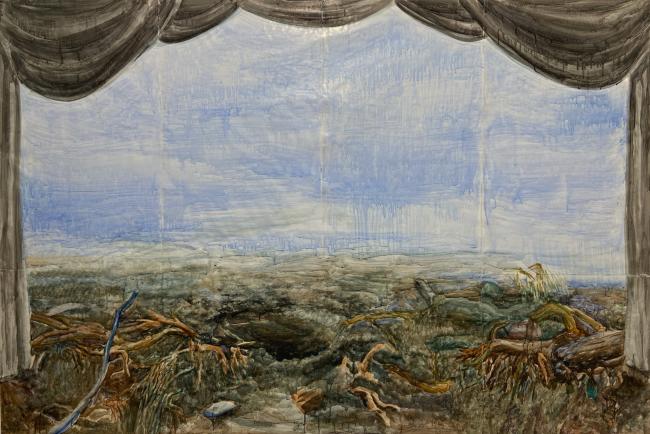
The mutilated European soil of Luhansk, as depicted in Kateryna Aliinyk’s work, is fertile and abundant. It sprouts mutated root vegetables, root-faces, bones, phallic forms, debris and shells. Kateryna, and with her we, hold front-row seats to the slow unfolding of a historical narrative, in which tragedy coexists with everyday life, and where, in an inescapable simultaneity, death triumphs over life, and life over death.
Sofiia Pomohaibo, whose practice is not represented in the archive but who, from the very first day of the full-scale invasion, has served in the military—an "artist in war", transitioning from a territorial defence volunteer to a senior combat medic—writes in one of her notes from 2022:
"…and then I understood what it meant when they said that surrealism is one of the reactions to war. dreams—you remember them most vividly in the moments just before an explosion.
sometimes it's the sea coast. more often—war. the day before yesterday, for the first time in a very, very long time, I dreamed of my childhood. my whole family. Kyiv. And then I was awakened by the blast.
today, we were once again talking about impossibility, about incredibility… the contrast.
absolute stillness before dawn, a light mist, birds calling back and forth, the sound of wings—
a pheasant takes flight, a bee-eater, its colours utterly insane, tropical, unreal. and then—a sudden burst of shelling, close by. everything you had been thinking about, everything you had been dreaming of—gone, you hear that sound, and it comes back to you—here, beside you, all around you, is destruction and death. and yet, you still cannot fully grasp it, you cannot accept it as one reality. more like dreams. one night—so many different dreams.
one life—so many realities, interwoven.”
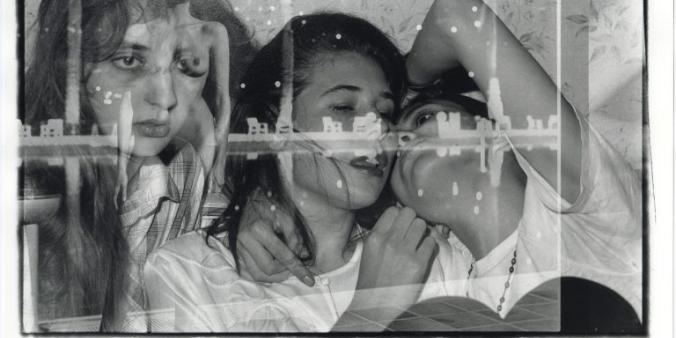
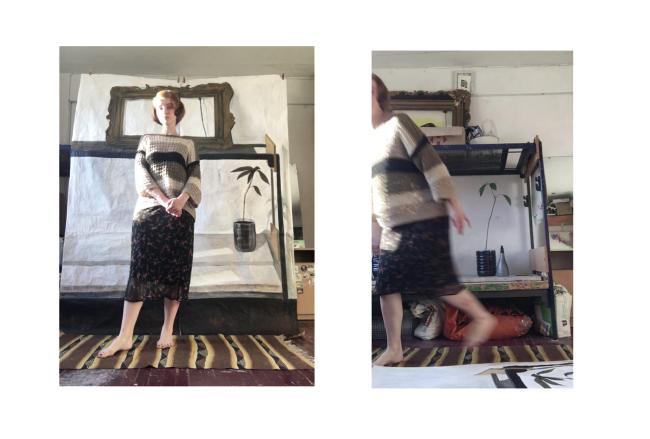
The interweaving of realities, layered upon one another, as Sofiia describes, can be glimpsed in the visual diaries of Inga Levi’s Double Exposure, in Lucy Ivanova’s How Can I Explain the World to a Newborn series, in Viktoriia Rozentsveih’s HPP and Memory works, and in the occupation diaries from Kherson, written by Yuliia Danylevska.
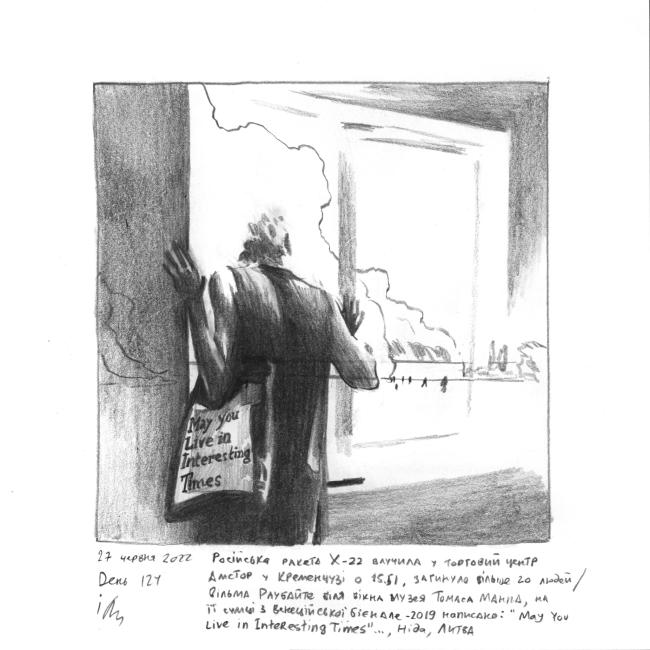
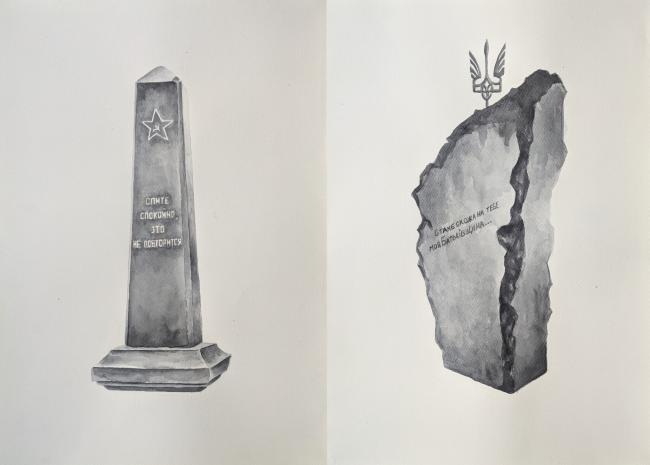
The catastrophes and traumas of the present irreversibly reshape the lens through which we see both the past and the future. (Sleep Well, It Will Not Happen Again by Olia Yeriemieieva; Warm Optics and Forever Changed Optics by Lucy Ivanova). This view becomes apocalyptic, looking both backward and forward, and even beyond human time itself, as in the work of Sana Shakhmuradova Tanska:
"Being concerned about the region’s uncertain future and unspoken past, I put my worries in the polemic about the immeasurable time span from the oldest times of Tethys to a possible future apocalypse. The symbols of the transgenerational traumas are represented in my work: the imaginary inhabitants of the deep sea who carry on the memory of all of the events of the past along with the ability to survive in future catastrophes."
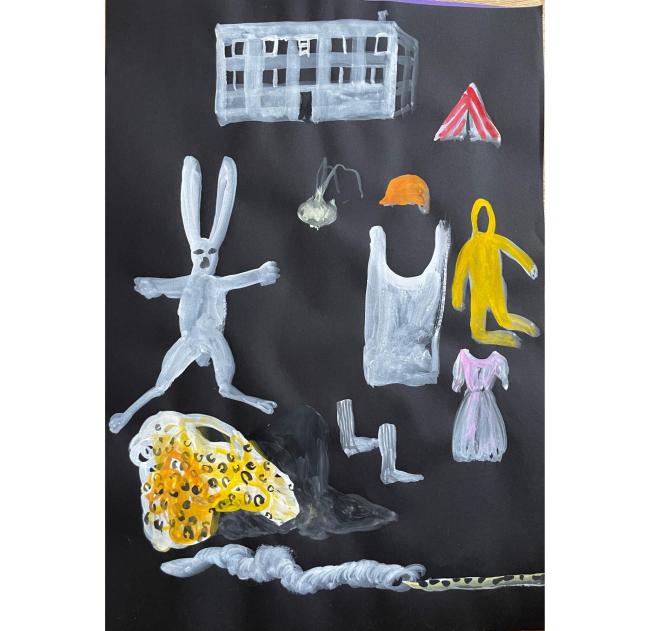
Karina Synytsia, in her work The universe before our great-grandmothers, turns to the past of her homeland through childhood memories of Severodonetsk, addressing the controversy of memory (and forgetting)—a tension that has shaped both the present and future fate of the region.
Memory—vulnerable yet far-reaching—emerges in the practices of these artists not just as a means of preserving information and emotions, but also as a mechanism of rescue and care, delicate memorials—forms of not just remembrance but existence, a continuation of life itself.
Among these works-monuments are: Fast, easy memory transfer by Karina Synytsia, where a studio is rolled up into a paper scroll; Anna Ivchenko’s sound monuments to landscapes; Daria Molokoiedova’s Autonomous Memorial RIA —a papier-mâché miniature of a destroyed pizzeria in Kramatorsk; Viktoriia Rozentsveih’s woven memories of light and shadow, We Were Here by Dasha Chechushkova—a plastered room-turned-memorial.
The online presentation of the new edition of the archive, which I had the opportunity to moderate, took place in early March—coinciding with the dismantling of the exhibition Our Years, Our Words, Our Losses, Our Searches, Our Us at Jam Factory Art Center. This exhibition, which I curated alongside Kateryna Iakovlenko and Borys Filonenko, included the works of several artists from the archive. Throughout the exhibition, many conversations emerged about commonality and difference, embodied in the pronoun "we", as well as other pronouns that seem to have become an inseparable part of exhibition naming during this war.
Olha Marusyn, who chose to manifest her multiplicities and explore certain pronouns instead of writing a personal text, reflects:
"It must be said that the choice of pronouns is a moment-to-moment, sensually spatial activity, and the constant assertion of one’s boundaries gives rise to a hunger that can only be satisfied by the kill. To the unfading sighs of “there are no ‘us’ ” and “who are ‘we’?”, it’s worth adding: “and who is this ‘I am’?’”
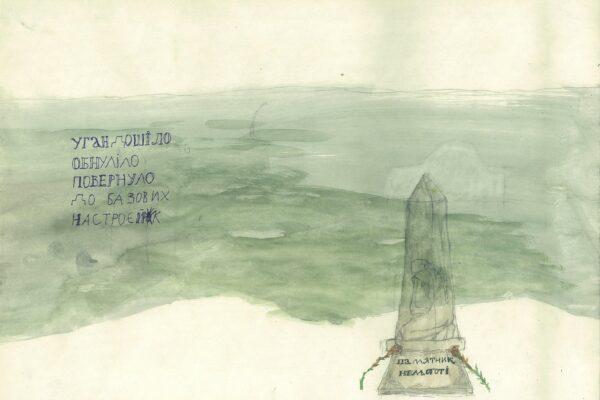
During the online archive presentation, Dasha Chechushkova spoke about her deeply personal graphic series Mournful Surf. The series consists of nine sheets, arranged in a continuous horizontal line, depicting the shore of the ‘dead’ sea. This work was created last year, following the artist’s visit to her native Odesa for her grandmother’s funeral, shortly after the destruction of the Kakhovka Dam. It is one of Dasha’s “monuments to ordinary life”, in which each day has now become a day of mourning. And the day of the archive presentation was no exception. Just hours before our broadcast, Russia launched another missile attack on Odesa, leaving many dead and wounded.
The backdrop (or rather, the foreground) of war makes isolated conversation impossible: the abyss is always in sight, even when it lingers at the periphery. To touch even the edge of this void is to be pulled into it, rendering the dialogue forever altered, never again as it was before.
“угандошіло, обнуліло, повернуло до базових настроєй☀к” ("Destroyed, erased, reset to defau☀lt")—these words appear on one of the pages in Dasha Chechushkova’s Mournful Surf. In this erasure, the depth of the Black Sea yawns open, the blackness of trench soil, the end of art as proclaimed by Malevich, and its topographical equivalent in Buchatska’s work.
During the presentation, Buchatska spoke of her encounter with the abyss, and of life and art after that. She described pigments made from Ukrainian soil and the works created with them, and she reminded us of the critical role of volunteer fundraising, which has now become an inseparable part of wartime daily life.
One of the most pressing questions when it comes to preserving art during war is not just how to protect the works themselves, but how to preserve the artists—their presence, their voices in the artistic field, whether they serve in the military, in volunteer efforts, or are simply striving to physically survive.
The archive presentation was accompanied by a fundraising announcement for medical equipment for one of its own artists—Marharyta Polovinko. Marharyta currently serves as a combat medic in a CASEVAC unit, the first line of evacuation for the wounded from the most dangerous and hard-to-reach areas of the front. In her artist statement, Marharyta writes: "All my themes are now related to the war. Previously, my works were about the shcheznyky [from Ukrainian: those who disappear; characters of Slavic mythology], about people on the periphery and outside the boundaries of cultural and social contexts. Now, when these people die due to missile strikes, they begin to exist, the war paradoxically “revives” them in a collective sense. The war shone a light, like a spotlight, and made everything visible and united in the light field: the theme of trauma, social unit, periphery, personal, collective."
Marharyta’s reflection on the changes in her own artistic practice echoes the mission of the archive, as stated in its description:
"This archive consists of artistic statements and unknown pages of the biographies and practices of women artists—where one can find the names of those who have been marginalised, neglected, forgotten, or who remain little-known to the wider public, as well as artifacts from key female figures in non-Western art."
Marharyta’s reflection on the changes in her own artistic practice echoes the mission of the archive, as stated in its description:
"This archive consists of artistic statements and unknown pages of the biographies and practices of women artists—where one can find the names of those who have been marginalised, neglected, forgotten, or who remain little-known to the wider public, as well as artifacts from key female figures in non-Western art."
For a long time, the war in Ukraine remained at the periphery of global attention. Now, two and a half years after the full-scale invasion began, we find ourselves in an endless loop of reminding others—and ourselves—that this war did not begin two years ago, but at least ten. "The war already influenced the Ukrainian women artists we included in the archive in 2022: some were born in territories that have been occupied since 2014," says Kateryna Iakovlenko, in a curatorial discussion about the archive. "The scale of the tragedy has expanded, violence has grown more pervasive, and the war has become all-encompassing, leaving total grief in its wake."
This sentiment resonates with the words of Daria Molokoiedova: "The war in my life began in 2014, but it was in 2022 that it intertwined with all of being, taking root. And even if I want to talk to you about flowers, they will turn out to be a wreath on a grave."
The physical, the bodily, the physiological—this theme surfaces again and again in the statements and works of these artists. From explosive root vegetables mutating into infant heads in Kateryna Aliinyk’s paintings, to Olia Yeriemieieva’s Sewn People and People Who Became Trees—to blood itself, which becomes not only a theme but a medium in the works of Marharyta Polovinko and Katya Libkind. For Libkind, blood even takes on the role of a character in her play-as-manifesto,as an embodiment of one of the artist’s own aspects of self.
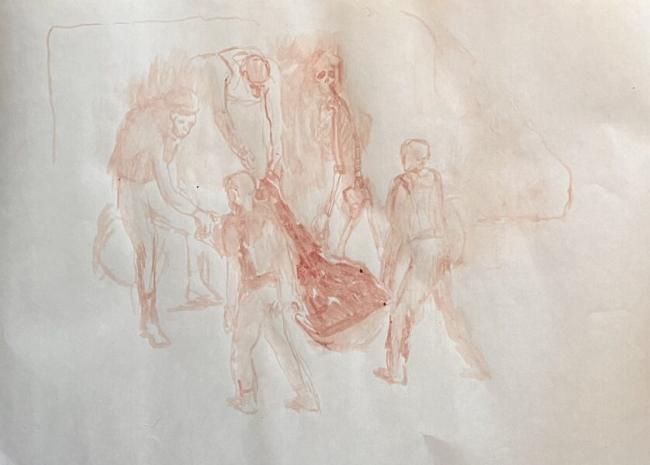
For Polovinko, blood becomes the ink for one of the few works in which she directly portrays her own experience. In this piece, Death helps people load black body bags—a scene drawn from Marharyta’s first time handling a body as part of her evacuation crew.
“When I start to paint, the blood is bright red. Just like the memory of trauma. Then the work fades, becomes brown or even green. The memory of trauma also remains, but its saturation, its colour changes. If something bad happens, we immediately want to cancel it. But over time, it becomes our experience, and we want to keep that.”
Even though she cannot be physically present in the art world, Marharita emphasises that for her, it is extremely important ”to understand and feel that I still have a place in civilian life, in a life with which I identify myself. For me, it is a great opportunity to have this little island where I exist as an individual, as an artist.”
Art, unable to compete with life, is nonetheless bound to life by its own fragility—and by a shared ultimate goal: to survive.
Here, we return to Olha Marusyn’s manifesto of multiplicities: "In the second year of the full-scale war, I realised — the only thing that interests me (worth working on, deserving attention, and focusing on), and I should be fully heard right now without interruption— is the search for eternal life."
Life and death, the two extremes, whose absolute presence overwhelms metaphor, become the inescapable frames through which every action unfolds in war, not to mention in art or language itself.
On the day that Russian missiles struck a printing house in Kharkiv, I saw a photo in Katya Libkind’s story—a pile of charred books, soaked with water from the firefighting efforts. Katya’s caption read: "Freedom from words. No words at all." Under these harsh conditions of freedom from words, this text, like any other, cannot stop a bomb. But at least art created near the abyss of a bomb (or after it) can outlast it.
Translated by Yuliia Elyas
The original text in the Ukrainian language was published in September 2024. On April 5, 2025, artist, volunteer and combat medic Marharyta Polovinko was killed on the frontline fighting for Ukraine’s freedom against brutal Russian aggression.