Search Artists
 Search Disciplines
 Search
Places
Search
Places
Image
Image
Role
Advisor for Belgium, France, Germany & the United Kingdom & Interim Advisor for Italy & Spain
Email
a.moerk [at] dutchculture.nl

 Angerfist Frans van de Staak (1943-2001) Theatre Utrecht Yin Yin Michael Tsalka
 Education
 Spain
Switzerland
Sweden
Milan
Edinburgh
Berlin
Spain
Switzerland
Sweden
Milan
Edinburgh
Berlin
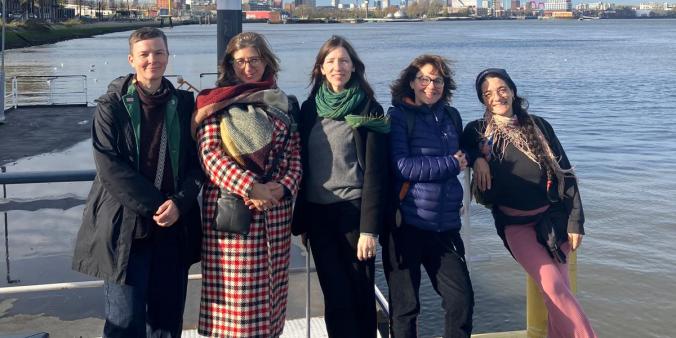
In November 2025, DutchCulture invited five cultural professionals from Belgium, France, Germany, Spain and United Kingdom to exchange about the regenerative practice in the cultural sector. The programme grew out of a shared curiosity: how can cultural work contribute to regenerating the living systems we are part of? Our five visitors are all part of cultural spaces abroad hosting exhibitions, events and residencies that are committed to improving the health of their ecosystems in a time of waning biodiversity and climate catastrophe. They offer alternative ways of experiencing a world that centers around more-than-human life through their cultural programming and art residencies.
In this article series, DutchCulture reaches out again to these five visitors to share their views on regenerative culture, important aspects of their organisations and residencies, and how you could be part of it.
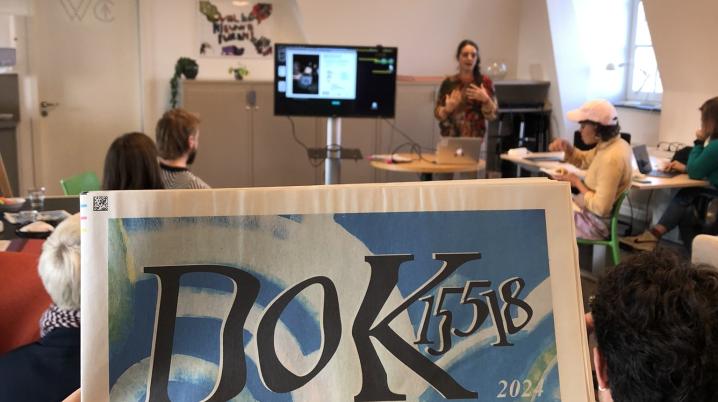
Julia von MuD is artist on duty at DoK 15518. Julia believes in the collective as the most contemporary form of art and art production. Collaboration is the foundation of live and care is the foundation of collaboration. Julia's collective MuD // logotorium uses care as an artistic method and tool. Their main question is: what does this (space, situation, group) need to fully flourish? They renovate, they build infrastructure, they draw, they write, they sculpt, they make music. They do what the artwork wants them to do, because it is the artwork that shapes the artist. This way they have been created by sound pieces, films, performances, shaped by manifestations. They were the hosts on a situationist campsite, curated an international music festival, developed immersive happenings and set up a few gardens.
Julia von MuD: ''DoK 15518 is a cultural hub and hosts events. DoK stands for Dorfkunst [village art], and 15518 is the postal code of our area. Our purpose is mainly focussed on care-centered practices of art and cultural production. Therefore we choose our topics accordingly, circling from queer ecologies to motherhood, to the first aid tending towards the admin-wound in our projects and back via the missing visibility of marginalized biographies in rural areas fostering safer spaces for the latter. We take care of shared resources that are open to be used by multiple players in our area like a sound system. In this sense we support local initiatives like the village library or pottery club, as the village is already very active in itself.
We want to prove that rural areas are far less boring and culturally deprived than people expect. Doing this we want to build connections between seemingly seperated ways of life, perspectives and build mutual understanding.''

Julia: "We believe that regeneration is more than just ecological. Together with the Community Shared Agriculture of our area we frequently work with the topic of ecology, but we also strongly believe that we need to regenerate our communities to fulfill the necessary socio-ecological transformation. This means that we strive to include our neighbourhoods in the artistic projects. This is for example done by focusing on youth-centered work by offering skate workshops, or by inviting experts from the village to host artistic workshops. Besides that, we strive for an eco-feminist approach, with care and feminism being the center of our practice. The transformation we need will not work without overcoming the patriarchal view on the world, a view that commodifies and makes nature a resource. Instead, we propose to put the needs of the human and more-than-human world at the center of cultural work. We do not want to see the rest of the world as separated from us, so instead of talking about our 'Umwelt' [environment, surrounding world], we call it 'Mitwelt' [in-vironment, with-world]. This is reflected in the choices we make for our artists to travel sustainably and the residency that centers on artists that are also caretakers of minors/children. In culture, there is often the approach of a single genius artist - often male - who needs nothing but his art. This is a very anachronistic and short sighted view."
Julia: ''I'd like to share two quotes from two different women. The first one is from Gertrude Stein: "Bevor es in der Stadt geschieht, geschieht es auf dem Lande" (Before it happens in the city, it happens on the countryside). The second one is from Rosa Luxemburg: "Heiter trotz alledem" (Joyfull, despite it all). Both show the necessary depth of regeneration, since they focus on the already existing life enhancing things around us.''
Julia: ''The last evening, the only hiccup in our meticulously planned itinerary. The taxi doesn't arrive. We fear missing our train, arriving late at the hotel, having to pack, getting up early. Keeping the spirits up, we wait. An idea strikes: maybe the taxi is waiting too. In the next town, in a street with the same name as this one. We call. We are right. Ten minutes later, a nine-seater squeezes through the narrow village street; we are many. A young man apologizes profusely. We wonder how long he's had his driver's license. No one asks him; we want to keep the good spirit. Turning the car in the narrow street, we worry about the rearview mirrors of the villagers. We squeeze along the shortest yet narrowest route towards the main road. At a bend leading to the main road, the taxi runs a red light, suddenly the lane in front of us is blocked. The taxi turns around again, gets stuck on the traffic island. This time we wait at the traffic light. Again the lane is blocked, and some of us realize we'd have to continue in the oncoming lane, hence the traffic light. The taxi drives into the oncoming lane, cars are coming towards us. "Stop!" we shout, and "You need to go backwards!" The young man apologizes, crosses the traffic islands again, and we start again. Everyone concentrates. This time it works: green light, correct lane, it's our turn, no oncoming traffic. Short time later, we reach the train station. We stop in front of the "no stopping" sign. The young man apologizes and offers not to charge the full fare. We decline. "This could have happened to all of us," we try to downplay the situation. "But," he says, "it DID happen to all of us; I just was the one driving." We laugh, all our fears fall away—whether we miss the train, arrive late at the hotel, still have to pack, or have to get up very early tomorrow. We're happy to be here together, together with the taxi driver, happy to have shared this stumbling in time.''

Julia: ''I highly recommend having a look at the different associations we are made up of. The ZUSANE - Zusammen in Neuendorf im Sande (Together in NiS) is an old Hachschara, they emphasise on memorial work considering the historical task of a place. Another collaborator is the association Traumtänzerin which focuses on kids and youth work that centers joy for and of live. The Community Shared Agriculture Lawine, an all FLINTA collective of agriculturists, deliveres to 80 households in the area biological fruit and veg. Moreover, the Haus des Wandels is a cultural and educational space that centers eco and queer feminist approaches, does a lot of youth work and fine arts, building an infrastructure that shows a highly aesthetic approach to self-organized space-making and co-living. Lastly, LandkunstLeben are the mothers of it all and have been doing all the cultural work that you can do on the countryside. It is their 25th birthday this year, so it's worth to check out their archive.''

Julia: ''We have different ways of collaborating. Keep an open eye for calls or contact us any time via [email protected]. We usually don't have the financial means to offer large artist fees, but we are always open to fresh ideas, especially connected to ecology, queerness and care. Do keep in mind that our aim is to involve people who live in our area if you propose a project. Most residencies/invitations to artist take place at the Haus des Wandels, a very rustic space with shared bathrooms, kitchens and no designated single artist studios. We wish for people interested in communal living, creating transformation togehter, maybe already have had some contact with the ideas of eco and queer feminism. If you are interested in ideas of commoning, ecological living, activism and seeing the purpuse of art in changing the world, please propose a project to us. We also are open to volunteers helping out at all the different events throughout the year. If you want to take part in the halloween happening, setting up for the summer party or do some wood work, definitely keep an eye open for the calls for help on our Instagram accounts. The next concrete deadline is the Open Call for the upcoming Artist with Children Residence on 15 April.''
DutchCulture connects regenerative ideas and practices across borders, enabling people‑to‑people exchanges that are rooted in fairness, mutuality, and long‑term trust. In an international context, this means working intentionally with partners to stimulate exchange. Our work has to be locally resonant to be globally relevant: we build networks of artists, cultural workers, and organisations who share the commitment to an interconnected world.
The word Zoöp is short for Zoöperation, cooperation with zoë the Greek word for life, ζωή, It is an organisation form and learning process that incorporates non-human perspectives into decision-making, advancing regenerative practice. The Dutch Zoöp-model was developed at Nieuwe Instituut in Rotterdam, the first Zoöp in the world, and set up the Zoönomic Institut to grow the Zoöp network. Any organisation with an intrinsic motivation to contribute to the health of the ecosystems they are part of, can become a Zoöp and learn how to contribute to the well-being of their multispecies communities.