Search Artists
 Search Disciplines
 Search
Places
Search
Places
Image
Image

Role
Advisor for Creative Europe Cultuur, European Heritage Collaboration, Spain & Italy
Email
j.hendrikse [at] dutchculture.nl

 ANOTR San Holo Eline Arbo Michael Tsalka Johan de Meij
 Education
 Austria
Netherlands
United Kingdom
Vienna
Madrid
Melbourne
Austria
Netherlands
United Kingdom
Vienna
Madrid
Melbourne
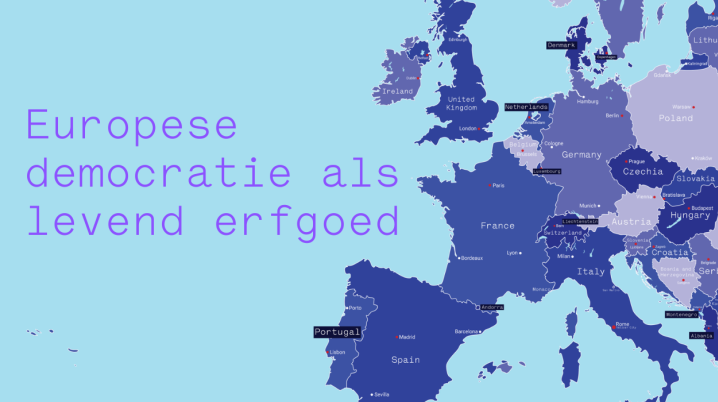
In January 2024, the Dutch government signed the Faro Convention. On the way to ratification and implementation of the convention, the Cultural Heritage Agency of the Netherlands (RCE) is working with the heritage field on an Implementation Agenda.
The government has set up a financial scheme for the period 2023-2025. This scheme is intended to bring the existing system heritage care and policy more in line with the Faro principles. Our project Democracy as Living Heritage, in partnership with the European Cultural Foundation, is granted under the third and final round of financial contributions from the Faro Implementation Agenda.
Democracy in its current form originated in Europe. From the Acropolis in the 5th century BC to the French Revolution in 1789 and resistance fighters opposing totalitarian regimes: countless moments and persons have contributed to anchoring democratic rights in law and creating the space for dialogue that is essential to a democracy. The European Union has enshrined democratic values in the Treaty on European Union—also known as the European “constitution.” Formally, all 27 EU member states have democratic governance, but in practice this is not always the case. In several European countries, democratic values are under pressure, including the rule of law, freedom of expression, and press freedom.
Research shows that Dutch young adults know less about democracy than their peers in comparable European countries. However, young people are generally positive about democracy and support it, as research by the University of Amsterdam earlier this year showed. Their democratic engagement, however, is strongly influenced by their educational and social background. It is precisely at school and at home that young people form their political preferences and the role they play in democracy, and they deviate little from this later in life. This is exactly why young people who are (almost) eligible to vote and still developing, aged 16 to 30, are an important group in this project.
Participation is essential for the functioning of a democracy. A parliament, court of law, and polling station only function if people debate, make arguments, vote, and provide oversight. Safeguarding democracy and democratic values is everyone’s responsibility, every day - but it requires democratic self-confidence.
The project Democracy as Living Heritage approaches democracy as a heritage practice: something people actively shape, pass on, and update. We link heritage institutions, which have experience with safeguarding heritage, with libraries throughout Europe that function as “democracy hubs”, and with young people, who are thereby engaged with heritage and democracy. The outcomes of this project will serve as inspiration for a new approach to heritage.
DutchCulture is happy to partner with the European Cultural Foundation (ECF) for this project. Both being residents of Domo, Home for International Cultural Collaboration in Amsterdam, this European project aligns with the organisation's goals and ambitions. Every year, ECF organises The Europe Challenge, a programme that brings together libraries and communities across Europe to address today's most pressing social, digital, and climate challenges. At the heart of the programme lies the belief that libraries and their communities are fundamental to shaping a more inclusive, connected, and sustainable Europe.
The European Faro Convention emphasises the social and connecting value of heritage and the importance of participation by society. Officially called the 'Convention on the Value of Cultural Heritage for Society', it was adopted by the Committee of Ministers of the Council of Europe in 2005 in the Portuguese city of Faro.